


In this article
What if you could sell T-shirts, mugs, hoodies, posters, and other products online…
without buying inventory first?
Sounds too good to be true?
That’s exactly what Print on Demand (POD) is designed for.
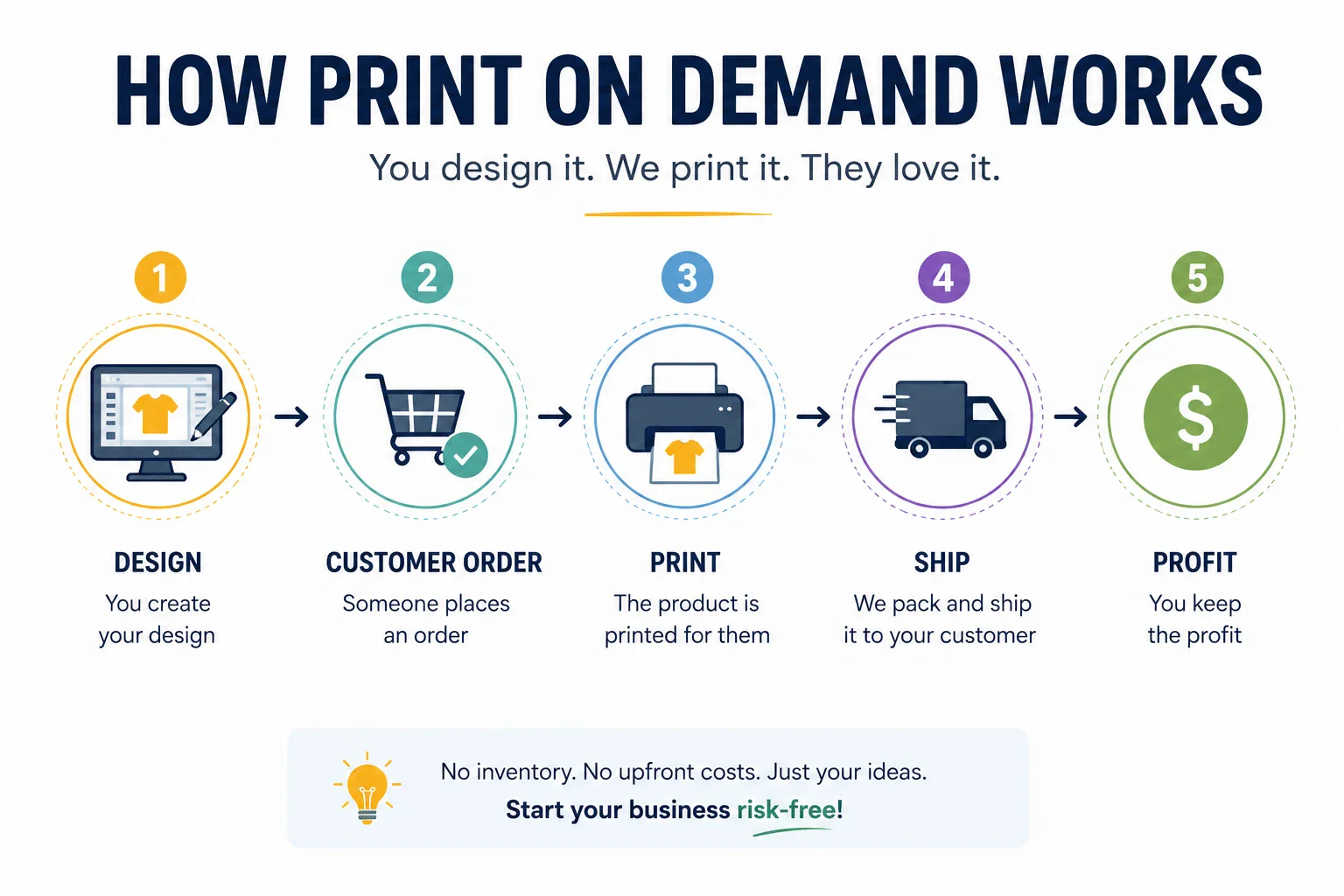
You create a design, upload it to a Print on Demand platform, add it to your online store, and wait for a customer to place an order.
When someone buys, the product is printed, packed, and shipped for you.
You don’t need a warehouse.
You don’t need to buy 100 T-shirts upfront.
And you don’t need to handle every order yourself.
But there’s one important question:
Can you actually make money with Print on Demand in 2026?
Let’s break it down.
What Is Print on Demand?
Print on Demand, often called POD, is an ecommerce business model where products are created only after a customer places an order.
Instead of buying products in bulk and storing them yourself, you work with a Print on Demand company that handles production and fulfillment.
Here’s a simple example.
You create a funny T-shirt design for coffee lovers.
You upload the design to a POD platform and add the shirt to your store for $29.
A customer buys it.
The Print on Demand company prints your design on the shirt, packages it, and ships it to the customer.
You keep the remaining amount after product costs and applicable fees.
That’s the basic idea behind selling products without inventory.
How Does Print on Demand Work?
The process is surprisingly simple.
Step 1: Choose a niche
Pick a specific audience instead of trying to sell everything to everyone.
For example:
Book lovers
Cat owners
Travelers
Coffee lovers
Fitness enthusiasts
Pet parents
Gamers
Teachers
Artists
Step 2: Create a design
Create an original design that fits your audience.
It could be:
A funny phrase
A simple illustration
A minimalist design
A seasonal idea
A personalized concept
A niche-specific joke
Step 3: Upload your design
Upload your artwork to a Print on Demand platform and choose the products you want to sell.
Step 4: Add the product to your store
Create your product title, description, images, and price.
Step 5: A customer places an order
You don't have to print the product yourself.
The POD provider receives the order and handles fulfillment.
Step 6: The product is shipped
The customer receives the finished product.
Your job is mainly to create products, build your brand, attract customers, and manage your store.
Is Print on Demand Profitable in 2026?
Yes, Print on Demand can be profitable, but it isn't a magic money-making button.
This is where many beginners get disappointed.
They upload a few random designs, wait for sales, and assume POD doesn't work.
The real opportunity is in building a store around a specific audience and a clear idea.
Your profit depends on things like:
Product cost
Selling price
Platform fees
Shipping costs
Advertising costs
Design quality
Competition
Customer demand
Your marketing strategy
For example, if your product costs $14 and you sell it for $29, the $15 difference isn't automatically your final profit.
You still need to consider other fees and expenses.
So before listing a product, calculate your real profit margin.
What Can You Sell With Print on Demand?
T-shirts are probably the first thing people think about when they hear "Print on Demand."
But POD is much bigger than T-shirts.
Depending on the platform, you may find products such as:
T-shirts
Hoodies
Sweatshirts
Mugs
Tote bags
Posters
Wall art
Stickers
Notebooks
Phone cases
Hats
Home decor
Accessories
The best product isn't necessarily the most popular one.
It’s the product that makes sense for your audience.
The Secret Isn't the Product. It's the Niche.
This is one of the biggest lessons for anyone starting a Print on Demand business.
Don't build a store that sells:
T-shirts + mugs + random quotes + cats + travel + fitness + everything else.
Instead, think about one specific audience.
For example:
Instead of:
A general T-shirt store
Try:
A brand for book lovers.
Now you have a clear direction.
You can create:
Book lover T-shirts
Reading mugs
Literary tote bags
Book-themed posters
Reading journals
Gift ideas for readers
Suddenly, you're not just selling products.
You're building a brand around an interest.
And that's much more interesting.
How Do You Find a Good Print on Demand Niche?
Don't start with:
"What should I design?"
Start with:
"Who am I designing for?"
That's a completely different approach.
Look for audiences with strong interests, hobbies, identities, or buying occasions.
For example:
Hobbies
Reading
Gardening
Fishing
Baking
Photography
Hiking
Lifestyle interests
Minimalism
Travel
Coffee culture
Fitness
Home decor
Gift-focused niches
Gifts for moms
Gifts for teachers
Gifts for pet lovers
Gifts for couples
Birthday gifts
Graduation gifts
The more clearly you understand your audience, the easier it becomes to create products they actually want.
What Makes a Print on Demand Design Sell?
A beautiful design isn't automatically a profitable design.
Think about the reaction you want from your customer.
You want them to look at the product and think:
"That's so me."
That feeling can come from:
Humor
Emotion
Identity
Personalization
A shared interest
A relatable situation
A special occasion
For example, a generic "Coffee Lover" design might be difficult to differentiate.
But a clever design aimed at a very specific coffee-loving audience could be much more memorable.
The goal isn't simply to make something attractive.
The goal is to make something relevant.
Do You Need to Be a Designer?
Not necessarily.
You don't have to be a professional graphic designer to start a Print on Demand business.
You can use design software and AI tools to help with:
Design ideas
Typography concepts
Product concepts
Content ideas
Product descriptions
Marketing ideas
But there's an important rule:
Make sure you have the right to commercially use the content you create.
Don't copy another creator's artwork.
Don't use copyrighted characters.
Don't use brand logos without permission.
And don't assume that something found on Google or Pinterest is free to sell.
Originality matters.
Best Print on Demand Platforms
There isn't one platform that's perfect for everyone.
Your choice depends on your target market, products, shipping locations, pricing, and store setup.
Some well-known POD platforms include:
Printful
Printful is a popular Print on Demand service that offers product customization and fulfillment options for ecommerce sellers.
Printify
Printify connects sellers with a network of Print Providers and offers a wide range of customizable products.
Gelato
Gelato is another major POD option, with a focus on local production and international fulfillment.
Before choosing a provider, compare:
Product prices
Shipping costs
Delivery times
Product quality
Available countries
Integrations
Return policies
Profit margins
Don't choose a provider just because it has the lowest base price.
A cheaper product isn't useful if the quality disappoints your customers.
Where Can You Sell Print on Demand Products?
You have several options.
Etsy
Etsy can be attractive for sellers who want to list products inside an established marketplace.
It can also be connected with compatible Print on Demand services.
However, always check Etsy's current seller policies and fees before starting.
Shopify
Shopify is useful if you want to build your own ecommerce store and develop a brand that you control.
You can connect your store to compatible POD services and automate much of the fulfillment process.
Other Marketplaces
Depending on your location, product type, and target audience, other ecommerce marketplaces may also be worth exploring.
The best option depends on where your customers already shop.
How Much Does It Cost to Start Print on Demand?
One of the biggest advantages of POD is that you don't have to purchase hundreds of products before you know whether people want them.
However, Print on Demand isn't necessarily 100% free.
You may have expenses such as:
Ecommerce platform fees
Marketplace fees
Payment processing fees
Design tools
Product samples
Advertising
Marketing
Product fulfillment costs
The good news?
You can start small.
Instead of spending thousands of dollars on inventory, you can test a small collection first.
If something works, scale it.
If it doesn't, move on.
Don't Upload 500 Designs on Day One
This sounds productive.
It usually isn't.
Imagine spending weeks creating hundreds of designs…
only to discover that customers aren't interested in most of them.
A smarter approach is to start with a smaller collection.
For example:
10–20 strong designs.
Then track what happens.
Which products get clicks?
Which designs get saves?
Which products get sales?
Which ideas attract attention?
Your data can tell you what deserves more attention.
Test. Learn. Improve. Repeat.
How to Market a Print on Demand Store
Creating products is only half the job.
The other half is getting people to see them.
You can promote your POD business through:
Pinterest can be particularly useful for visual products such as wall art, fashion, gifts, home decor, and personalized products.
Instead of posting:
"Buy My T-Shirt"
create content around the customer's interest.
For example:
Unique Gift Ideas for Book Lovers
Then feature your products naturally.
Show your products through lifestyle images, Reels, carousels, and behind-the-scenes content.
TikTok
Short-form videos can be used to show:
Idea → Design → Product
This can make the creation process more interesting than simply showing the finished product.
SEO
Search engine optimization can help people discover your products through Google and other search engines.
Instead of naming a product:
Cute Shirt
you could create a more descriptive title based on the actual product and target audience.
For example:
Funny Cat Lover T-Shirt – Gift for Cat Owners
The key is to use keywords naturally.
Don't turn your product title into a list of repeated keywords.
Use Content Marketing to Grow Your POD Business
Here's a strategy many beginners overlook.
Don't rely only on product pages.
Create helpful content around your niche.
For example, if your store targets book lovers, you could publish articles such as:
10 Unique Gifts for Book Lovers
or:
Best Gift Ideas for Readers
or:
Cute Home Decor Ideas for Book Lovers
Then naturally feature relevant products inside your content.
Now you're building more than a store.
You're building:
Content + SEO + Pinterest + Products + Brand
And that can create multiple ways for people to discover your business.
Can AI Help With Print on Demand?
Absolutely.
AI can help you move faster when brainstorming and creating content.
For example, you can use AI to generate:
Niche ideas
Product concepts
Slogan ideas
Blog topics
Pinterest content
Product descriptions
Marketing angles
But don't let AI replace your creativity.
The goal isn't to generate 1,000 generic designs.
The goal is to find better ideas for a specific audience.
And always check the commercial-use terms of the tools and assets you're using.
Common Print on Demand Mistakes
Copying Other Sellers
Seeing a successful design doesn't mean you should recreate it.
Build your own concept.
Using Copyrighted Characters
Popular movies, games, celebrities, logos, and characters can be protected by intellectual property rights.
Don't assume you can use them because other sellers are doing it.
Ignoring Shipping Costs
A product may look profitable until shipping costs are included.
Calculate everything before setting your price.
Choosing a Supplier Only Because It's Cheap
Quality matters.
A customer who receives a poor-quality product may never buy from you again.
Trying to Sell to Everyone
A store with no clear audience is harder to market.
Start narrow.
You can always expand later.
Expecting Instant Sales
POD is still a business.
You need testing, marketing, patience, and improvement.
Is Print on Demand Passive Income?
You'll often see POD described as passive income.
There's some truth behind that, but the term can be misleading.
Once your store is set up, many fulfillment tasks can happen automatically.
A customer orders.
The provider produces the product.
The product is shipped.
You don't have to package every order yourself.
But you still need to:
Create products
Research niches
Market your store
Improve listings
Handle customer questions
Analyze performance
Test new ideas
So think of Print on Demand as a business that can automate fulfillment, not as money that appears without work.
Can You Start Print on Demand From Home?
Yes.
That's another reason the model attracts beginners.
You can manage most of the business remotely using:
A computer + internet connection + design tools + a POD platform + an online store or marketplace.
You don't need a warehouse or printing equipment.
But you should still check the legal, tax, payment, and business requirements that apply in your country.
A Simple Print on Demand Business Plan
If you want to start without overcomplicating things, follow this basic path:
1. Pick one niche
Don't start with everything.
2. Research your audience
Understand what they like and what they buy.
3. Create 10–20 original designs
Focus on quality and relevance.
4. Choose your products
Start with a small selection.
5. Pick a POD provider
Compare quality, pricing, shipping, and fulfillment.
6. Choose where to sell
Etsy, Shopify, or another suitable marketplace.
7. Create strong product listings
Use clear images, descriptions, and relevant keywords.
8. Start marketing
Use Pinterest, Instagram, TikTok, SEO, or other channels that fit your audience.
9. Track the results
Don't guess.
Look at clicks, views, saves, conversions, and sales.
10. Double down on what works
If a niche or design performs well, create more products around that idea.
So, Is Print on Demand Worth It in 2026?
If you're looking for a way to enter ecommerce without buying a large amount of inventory upfront, Print on Demand is definitely worth exploring.
But the opportunity isn't simply:
"Upload a design and make money."
It's:
Find a niche → understand the audience → create something they want → build a store → market it → test → improve.
That's the real game.
You don't need hundreds of products to get started.
You don't need a warehouse.
You don't need expensive printing equipment.
You need a good idea, a specific audience, consistent testing, and a willingness to learn.
And if you can turn a simple design into something people feel connected to, you may have more than just a product.
You may have the beginning of a real ecommerce brand.
Frequently Asked Questions About Print on Demand
Can I start Print on Demand with no money?
You can start with relatively low upfront costs because you don't need to purchase inventory in bulk. However, depending on your setup, you may still need money for platform fees, samples, marketing, design tools, or other business expenses.
Can I do Print on Demand without a website?
Yes. You can sell through marketplaces that support POD instead of building your own ecommerce website. A website can become more useful as you grow your brand.
Can I sell Print on Demand products internationally?
Potentially, yes. International selling depends on the POD provider, shipping availability, your sales platform, payment methods, and the countries you want to serve.
How long does Print on Demand shipping take?
There is no universal shipping time. It depends on the production location, product, fulfillment provider, destination, and shipping method.
What happens if a customer receives a damaged product?
The exact process depends on the POD provider and marketplace. Many providers have procedures for damaged or defective products, so you should understand their policies before launching your store.
Can I use the same design on multiple products?
Usually, yes, as long as the design works well with each product and complies with the platform's requirements. A design that looks great on a T-shirt may need adjustments for mugs, posters, or other products.
Can I sell Print on Demand products on multiple platforms?
In many cases, yes. You can potentially sell through multiple marketplaces or your own store, provided you follow the rules of each platform and your POD provider.
Do I need a business license for Print on Demand?
Requirements vary by country and business structure. Check the rules that apply to your location before operating commercially.
Is Print on Demand better than Dropshipping?
They are different business models. POD focuses on customizable products that are usually created after an order, while traditional dropshipping generally involves selling existing products supplied by a third party.
Can I combine Dropshipping and Print on Demand?
Yes. Some ecommerce stores use both models, although it's usually easier to build a strong brand when the products are connected by a clear niche.
How do I know if a Print on Demand niche is worth trying?
Look for a combination of audience interest, buying intent, manageable competition, and enough room to create multiple original products.
Should I order samples before selling?
Ordering samples can be a smart move. It lets you check the product quality, printing, sizing, packaging, and overall customer experience before promoting the product heavily.
Can I change my Print on Demand provider later?
Often, yes, although the process depends on your ecommerce platform and integrations. Before switching, check how products, orders, inventory information, and customer data are handled.
Can Print on Demand become a full-time business?
It can for some sellers, but there is no guaranteed income level. Turning POD into a full-time business usually requires strong products, consistent marketing, good margins, and ongoing optimization.
What is the biggest challenge in Print on Demand?
For many sellers, the hardest part isn't uploading products.
It's getting attention in a crowded market.
That's why niche selection, original designs, branding, SEO, and marketing matter so much.
Keep up with AI Tech Insider
Choose site notifications, email, or both. Guests can subscribe by email without an account.
Report this article
Tell our review team about a problem with this content. Your details will not be shown to the author or other readers.
Your report could not be sent. Please try again later.
Sign in to report an article
Discussion
comments (0)
Share a perspective. Start a thoughtful conversation.
please login to be able to comment